
"Everything's Expensive" is Negative Social Contagion
Take basic precautions to stop the spread

I went on a quick errand today, to the pharmacy and grocery store. I got only a few items in each place. It cost $100. A natural thought is “leave your house these days, and it costs $100!” Which is true, in the sense that $100 just isn’t that much money anymore. On a different scale, neither is $1M; when I was a little kid it seemed like a big deal to be a millionaire, and now every 65-year-old who owns a house in a major city qualifies. And by the time I’m 65, it’ll be required for non-destitute retirees.
On paper, everyone knows this, and it’s called inflation. “Penny candy” used to be a literal description of certain physical objects, and “dollar menus” were popular at fast food chains in my millennial memory.
Viscerally, though, there’s a temptation to say phooey, and resent the fact that a bigger number is required to meet basic needs. I posit that this temptation gets its spark from human nature; we don’t respond very well when things get better on one dimension (rising salaries) and worse on another (rising expenses), even if the combination is obviously good on paper (salaries rising faster than expenses). But it gets its tinder from social contagion, and thereby becomes a bad habit.
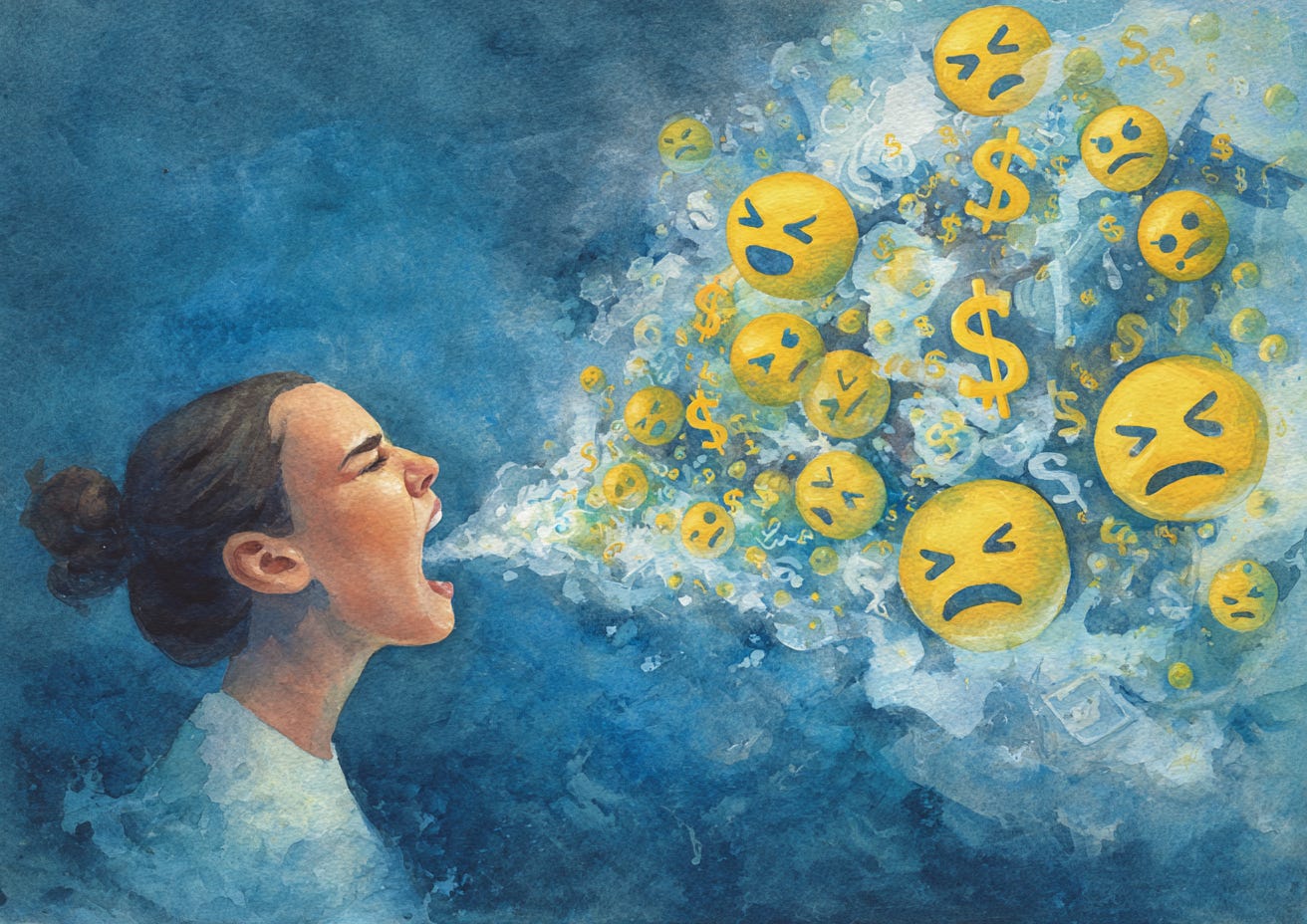
Socially, if you comment on how stuff is expensive these days, you can’t lose. You’re pointing out a problem that everyone has, so your interlocutor is almost guaranteed to be sympathetic. If you’re struggling financially, you’ll feel less alone. If you’re doing fine in that department, you avoid seeming out of touch. So it’s pretty easy to install a habit where, whenever you buy anything, how much it cost becomes an automatic object of small talk. Unlike the weather, though, or other benign topics, “stuff is pricey” mostly serves to make people feel bad. And in aggregate, this is actually a problem, since it contributes to people thinking “the economy” is bad any time prices are rising, and when people think “the economy” is bad they want to rock the boat and make facially insane political choices.1
Doing Your Part
I can think of a few ways to break the cycle.
The easiest is to mention prices less. Once you understand that there’s a silly bug in human cognition, such that it’s hard to accept that things are nominally more expensive every few years, then the topic is pretty boring. Cheap fast food items are $5 rather than $1. Eventually they’ll be $10, then $20, and then you die. So it goes.
A second option is to delight when things are cheap. I try to trigger childlike wonder in myself whenever I’m in a grocery store, at least once. This place really exists? I can get that much rice for that little money? There are more ways to meet caloric needs on a shoestring budget than grains of sand would fit in the universe, all available in a five minute drive. Or take video games. $60 for 60 hours of high-quality entertainment? If you’re busy, you can access gamer bliss for months on the cost of a few Chipotle orders. Nor was it always thus! Yesteryear’s games were, in real terms, dramatically more expensive. Also yesteryear we were children, and at the mercy of our parents. And so on. Gratitude is always available, should you look, including in the realm of prices and values.
The hard part, of course, is when other people complain about prices to you. I think the trick here, if you believe there’s a bad social contagion afoot, is not to offer much reward. You shouldn’t contradict the person; they may be struggling, and what’s the point of fighting about this? But you can change the subject, say something bland and noncommittal, or take a stoic line, like “inflation do be that way.” It’s a stupid hill to die on, stuff not actually being that expensive.2 But no need to feed the beast.
Same deal with “the job market.” People always get points for saying it’s bad, since if it’s good you might feel bad about not seeking a better situation or might not feel as personally responsible for your good fortunes. Thus, the idea spreads that it’s bad, and uninformative metrics like “number of applicants per job” spread to fuel that notion. And then people think stuff sucks in general and want to flip the table over, despite (mostly) individually doing fine.
Yes, I know houses and education and medical care are, and I know that there’s a really satisfying and shareable argument about how thus things are generally bad. If you are tempted to return to that argument, again and again, you might be in the throes of a related social contagion that is making your life worse, and I hope you feel better soon.
For about 5 years I've had a little hobby farm...well, really just a big garden and a flock of chickens. I love it, but I'll never complain about grocery store prices again. Technology, comparative advantage, and markets are amazing! Happy New Year!
I am infrequently guilty of this and you have convinced me to stop. There are definitely happier, better topics of conversation, and we should probably mostly avoid negative topics as a rule. (Of course, shared trauma and frustrations can help bonding.)
Do you know if there's any literature or other essays that discuss "fictitious" negative social contagion like this and what, if anything, results from it?