
Sweet Nothings
Trying is trying

When I was a kid, I played Super Smash Bros. Melee.1 I played Falco. Falco has the highest jump out of all the characters; he really soars up there! I enjoyed dancing around, dodging by surging way up high, and then, when my opponents least expected it, busting out a roundhouse kick.
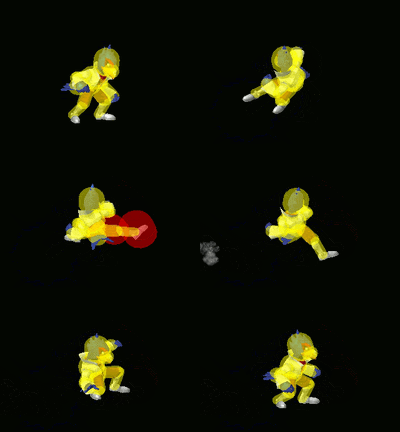
I was the best Melee player of my friends, but I’d never really practiced. My skills, like all of their skills, were earned purely by playing against each other. I was the best, mostly, because my house was where we’d gather to play!
Then one day, I discovered… well. I’ll just show you.
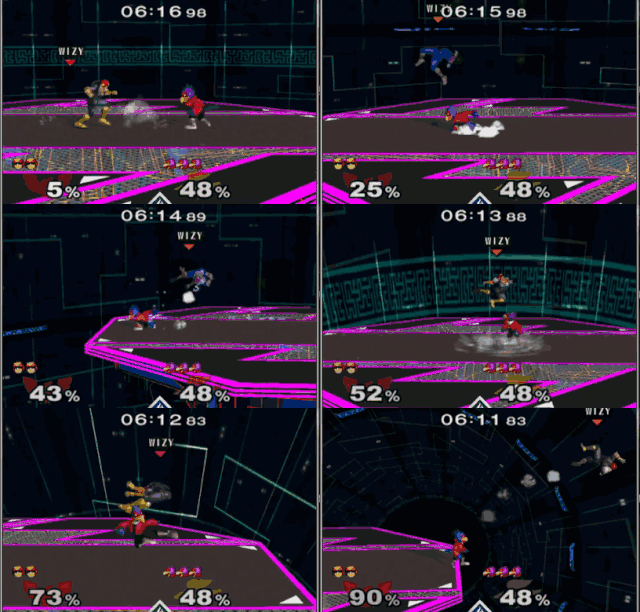
What was he doing? Rather than sailing up high, he hugged the ground, zipping back and forth at insane speeds while keeping his opponent trapped in a flurry of attacks. Could I do that?
In a lesser form, yes. But it required practice. Sitting alone in my living room, practicing tapping the y button very gently, so that Falco would do only the tiniest jump. Reading guides online. Going to a local college student’s dorm (driven by my mom, naturally), where we just… did little hops together, since that was all my level of skill allowed.
I got slightly worse at the game, for a while, and my friends beat me more often. Then it clicked, and they couldn’t touch me.
I invited my friends to learn the same techniques. A couple tried it out with me, but none stuck with it. It wasn’t for lack of talent, or even of not having enough time; to go from casual to competent at Melee probably takes 10 or so hours of practice, and we were 9th graders with mountains of time.2
I think the biggest obstacle wasn’t that training was boring or frustrating. Rather, it was that really trying instantiated the game with greater emotional stakes. Serious, goal-directed effort at Melee transforms you into a Melee player. At which point you care how good you are compared to other Melee players. And given that Melee players are specifically the people who have bothered to practice, you’re one of the worst.
There’s a subtle point here: this cuts in two separate ways! First, you now are comparing yourself to a new reference class, which is maximally unflattering to you. And second, by joining that reference class, you care extra about comparisons within it! If you’re worse than your coworkers at throwing axes, and learn that at a teambuilding event, well, who cares? But if you come in last place at the local axe throwing league, after 10 hours of practice? Torture.
A Nod and a Bridge
My point so far is not novel. Sasha Chapin calls it The Moat of Low Status, and describes the feeling well. When you simply don’t care about some activity, it doesn’t feel low status to suck at it. But if you do care - which you prove to yourself and others by trying - it feels awful.
I’m happy to reiterate Chapin’s point; it’s a good one! But also, I’d like to generalize it. Because I think even in cases where status or skill are irrelevant, low investment can be sticky. Including more than it should be.
Money, Friendship, Meds
Once upon a time, my wife was watching Xena: Warrior Princess. She loved the show as a kid, and loved revisiting it. Then Amazon Prime started running ads. My wife hated the ads, and stopped watching the show. Over the course of a few weeks, I eventually convinced her to let me pay a few extra dollars a month. Once we did, the ads were gone, and she enjoyed Xena again.
Am I therefore wise, embodying Taoist/stoic virtue and letting myself be as water, rather than struggling against the great forces of the market? Ha! In fact, for no good reason at all, I still haven’t paid for YouTube premium, despite hating the ads and listening to music there for multiple hours a day.
When you aren’t yet paying for something, especially a recurring charge, it’s painful to start. I don’t think this comes down to status; I wouldn’t feel like a sucker paying for YouTube premium. But deciding what to pay for takes mental energy and willpower, and the simplest equilibrium is just not paying for anything new.
Sometimes, in other words, the barrier to doing something isn’t shame or social comparison, but rather an overactive defense mechanism against exploitation.
Nor is it a bad mechanism! I probably should just buy premium YouTube, but it’s a good instinct, in free-to-play video games with microtransactions, not to pay a cent.
Friends
If I run into someone occasionally in public and say hello, that acquaintanceship is pleasant and stable. If I start texting them trying to hang out, even a little, the relationship is permanently changed. There are people I consider friends, who I’ve seen serendipitously dozens of times, where neither of us ever put any effort into our association.
This does relate to status in some sense; social rejection is one of the most reliable ways to have painful status feelings. But it’s got little to do with skill! It could be my first friend in a new city or my hundredth; trying to befriend them will probably hurt.
Meds
There are roughly a zillion types of medication out there. Many people benefit tremendously from one or more medicines, elective procedures, or supplements. But most people aren’t Gwern, actively and assiduously trialing chemical interventions.
Why not? Well, getting it wrong can ruin your life, so there’s a strong default to keep one’s brain chemistry the same. Tons of people, including plenty who are cisgender, would probably benefit tremendously from testosterone or estrogen, but the dialogue around hormone therapies is all about bright lines and clear identity markers. Lots of people have wonderful, life changing experiences on LSD, and lots of others go permanently crazy. The simplest rule to follow is to just keep things the same.
Just Do Things?
Well, maybe. I suspect the world would be a better place if people were more willing to pay for services they regularly use, practice hard at their hobbies, invite people on friendship dates, and consult with a psychiatrists to give low-dose medications a shot. But in all these cases, the relevant margin is thin:
I’ve known teenagers who, despite being among the best 5% of Smash Bros players on earth, are actively depressed because they’re “bad” compared to pros
People can and do waste hundreds of dollars on recurring subscriptions they never use and just forget about
Trying to join a social community where you don’t fit doesn’t make your life better, so rejection signals are valuable information
Some people totally do way more drugs than would be best for them, prescribed or otherwise
So if not “just do things”, what’s the takeaway? Well, for me it’s close to (but not quite) the opposite. When I decide to try hard at something I previously did passively, I expect it to hurt, and try to take pride in the effort. Perhaps you should, too!
Now, of course, I play Project+, a mod of Super Smash Bros. Brawl that changed its name from Project M when Big Mario started sniffing around.
Years later, after college, I did finally find a guy who wanted to be my apprentice. As is tradition, he eventually surpassed me, even beating me out for first at a tournament with a cash prize! Life can be wonderful.